
From activities to impact: how to design a results-driven CDE work package in Horizon Europe projects

A Horizon Europe proposal can be technically excellent and still lose points on its impact section. One of the most common reasons is a weak approach to communication, dissemination, and exploitation (CDE). Evaluators quickly recognise when CDE is treated as a list of promotional activities rather than a strategy to ensure that project results generate real uptake. Impact is not measured by visibility alone.

Proposals must demonstrate how project results will reach relevant stakeholders, how barriers to adoption will be addressed, and how outputs will translate into scientific, societal, policy, or market effects.

While the programme does not strictly require a dedicated CDE work package, beneficiaries must have a credible plan and appropriate resources. Structuring these activities within a dedicated work package remains the most practical solution to clarify responsibilities and budgets.

Why generic CDE plans fail?

Many proposals include a standard list of communication actions: a website, social media channels, newsletters, conference participation, and a final event. These activities add little value when they appear without strategic context. Evaluators are left wondering who the project needs to influence and what those actors are expected to do with the results.

Effective planning starts with the project’s expected outcomes and key exploitable results. For each result, the consortium should identify the relevant users, define the engagement mechanism, and anticipate barriers to uptake.

This shift from activity-based thinking to outcome-oriented planning is critical. Instead of stating that the project will organise workshops, a stronger proposal explains that workshops will bring together specific stakeholders to validate results or support pilot implementations.

Connecting CDE to the impact pathway

A practical way to strengthen a strategy is to map project outcomes to target audiences and uptake mechanisms.

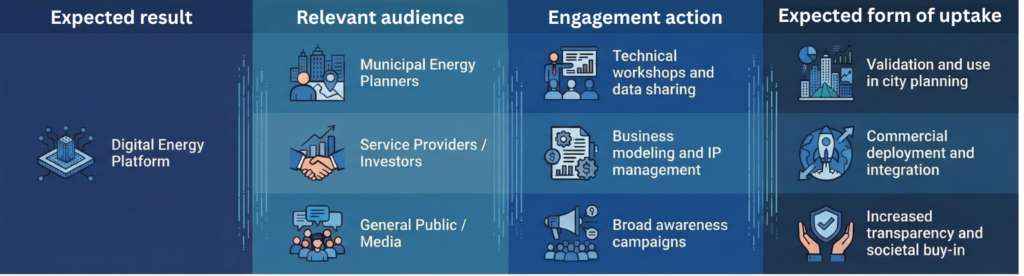
Many successful proposals start with an internal matrix linking the expected result, the relevant audience, the engagement action, and the expected form of uptake. This prevents the common mistake of treating all stakeholders as a single group.

Researchers, policymakers, and industrial actors have different interests and decision processes, requiring tailored messages.

For example, a digital platform project might use communication to raise public awareness, dissemination to provide technical data to municipal planners, and exploitation activities to reach investors interested in integrating the platform. Describing these pathways clearly helps evaluators understand how results will move to real-world use.

Communication, dissemination, and exploitation: distinct but complementary

One recurring weakness is the tendency to use the terms interchangeably. In practice, each has a specific role.

Communication refers to promoting the project to broad audiences, including the public and media. The objective is to create awareness and ensure transparency about how EU funding tackles societal challenges.

Dissemination focuses on sharing results with actors who can validate or build on them, such as researchers or public authorities. This often includes scientific publications or open data sharing.

Exploitation concerns the actual use of project results. This involves commercialisation, policy implementation, or integration into industrial processes, closely linked to intellectual property and business models.

What evaluators expect from a credible CDE work package

A strong CDE work package explains how activities contribute to expected outcomes. It defines target audiences precisely, specifying which regulators or investors will be engaged rather than using broad categories like “end users”.

It outlines a strategy for each key exploitable result. It also defines governance, clarifying who leads communication, dissemination, and exploitation.

Furthermore, it includes meaningful indicators. Stronger indicators measure real engagement and uptake, such as pilot collaborations or commercial interest. Finally, a convincing plan considers sustainability beyond the project duration, showing how results will be maintained once EU funding ends.

Frequent mistakes in CDE planning

Several recurring issues weaken strong proposals. When communication and dissemination are disconnected from technical work packages, it becomes difficult to explain how results will move from development to adoption. Using the same engagement approach for all audiences ignores different technical needs. Proposals also often underestimate exploitation readiness by leaving intellectual property and market pathways vague.

Finally, postponing exploitation activities until the end of the project is a mistake; preparation for uptake should start early.

Moving from visibility to impact

A well-designed CDE strategy creates the conditions for results to be understood, adopted, and used by relevant actors. By linking communication, dissemination, and exploitation to expected outcomes, consortia can demonstrate that their work will deliver benefits beyond the duration of the project.

At Euro-Funding, we support consortia in designing robust strategies. Our team leads the CDE work package in eight active EU-funded projects, allowing us to translate evaluation expectations into practical, results-driven strategies.

If you are looking to reinforce your CDE approach, feel free to contact us to maximise your project’s impact.

LATEST NEWS

News

Coordinating EU collaborative projects

Coordinating EU collaborative projects: when execution marks the difference Lucía Duque Teva( Project Manager European Funds )Settings Coordinating a European collaborative project goes far beyond convening meetings or collecting deliverables….

Read more
News

EU Added Value in LIFE Proposals

EU Added Value in LIFE Proposals Fernando Gómez( Technical Manager – European Funds )Fernando Gómez es Technical Manager – EU Projects en Euro-Funding desde 2020, con experiencia coordinando propuestas europeas…

Read more