The EU’s 2028-2034 budget proposal
Actualmente, como Director de Asuntos Europeos en Euro-Funding, cuento con más de 14 años de experiencia en análisis e incidencia política pública europea, especialmente en los sectores de las energías renovables y solar. Dirijo la oficina de representación en Bruselas, establecida en 2022, centrada en programas de financiación europeos como Horizonte Europa y el Fondo de Innovación. También soy miembro del Consejo de Administración de la EAIC, donde colidero el Grupo de Trabajo del Fondo de Innovación y contribuyo activamente a iniciativas de incidencia relacionadas con las negociaciones del presupuesto de la UE para 2028-2034.
Apasionado por la cooperación y la coordinación, me esfuerzo por establecer alianzas estratégicas y supervisar análisis competitivos detallados en toda Europa. Mi función también incluye la gestión de proyectos financiados por la UE para E.DSO, desde la formación de equipos hasta la gestión financiera. Mi objetivo es seguir impulsando el crecimiento de nuestras actividades en Europa, a la vez que reforzo nuestra posición en el ecosistema europeo de innovación e investigación.
On 16 July 2025, the European Commission presented its proposal for the Multiannual Financial Framework (MFF) covering the period 2028 to 2034. With a proposed volume of nearly €1.98 trillion in current prices, this budget marks a significant step in the evolution of EU financial governance. Beyond its size, it reveals a clear strategic repositioning: the EU aims to streamline its financial instruments, increase flexibility, and address the major challenges of competitiveness, sovereignty, and security.
At Euro-Funding, we have analysed the numbers in detail. Our objective: understand how this new financial framework compares with the current one, and more importantly, what opportunities it may open for stakeholders across Europe — from industry and research to public authorities.
From COVID-19 recovery to long-term strategic planning
To fully appreciate the magnitude of the 2028–2034 MFF, it is necessary to compare it not only with the last MFF (2021–2027), but also with NextGenerationEU (NGEU) – the unprecedented recovery instrument launched in response to the COVID-19 crisis. While the core MFF for 2021–2027 amounted to around €1.07 trillion, NGEU added another €807 billion, bringing the total to approximately €1.88 trillion.
The new MFF is therefore only slightly larger in financial terms – €1.98 trillion – but conceptually very different. It is no longer a budget shaped by crisis response. It is a forward-looking investment tool designed to build the EU’s resilience, autonomy, and strategic capacity.
A Simpler Structure for a More Strategic Budget
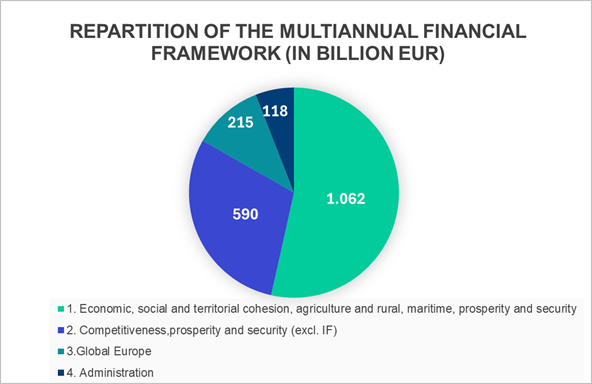
The proposed MFF simplifies the budget structure from seven headings to four, helping reduce fragmentation and allowing for more coherence in implementation. These four headings are:
- Economic, Social and Territorial Cohesion, Agriculture and Rural Prosperity, and Security – €1.06 trillion
- Competitiveness, Prosperity and Security – €590 billion
- Global Europe – €215 billion
- Administration – €118 billion
Heading 1 remains the largest, combining traditional cohesion and agricultural policies with broader security dimensions. But Heading 2 — dedicated to innovation, competitiveness and strategic industries — is where the real transformation is taking place.
Heading 2: Where industrial policy and innovation meet
Heading 2: Competitiveness, Prosperity and Security is allocated €590 billion, a substantial increase compared to its predecessor’s envelope in the 2021–2027 cycle. This reflects a decisive pivot toward supporting Europe’s strategic industrial autonomy, technological leadership and global competitiveness.
The headline innovation within this heading is the creation of the European Competitiveness Fund (ECF), which alone is allocated €450 billion. Horizon Europe, the EU’s flagship R&I programme, is maintained with a nearly doubling budget of €175 billion, ensuring a comprehensive support system from basic research to industrial deployment.
What is the European Competitiveness Fund?
The ECF represents a new generation of EU funding instruments. It aims to finance the scaling-up of strategic technologies such as:
- Clean and renewable technologies
- Advanced semiconductors and AI
- Biotech and health tech
- Defence and dual-use innovation
- Industrial decarbonisation and digital infrastructure
Unlike Horizon Europe, which focuses on early-stage research and innovation, the ECF is designed to bring innovation to market, help close the gap with global competitors, and reinforce Europe’s technological sovereignty. It will also be linked to other instruments like InvestEU, IPCEIs, and the Innovation Fund, enabling significant leverage of private and public investment.
In fact, the creation of the ECF marks a major consolidation of several existing EU programmes. Various instruments from the 2021–2027 period are expected to be absorbed or restructured under the ECF umbrella. This includes the Innovation Fund, parts of InvestEU (notably those targeting industrial and technological sectors), and components of the Digital Europe Programme. The European Defence Fund, previously a standalone budget line, will also likely be integrated into the ECF’s sovereignty strand. In addition, thematic elements from EU4Health, LIFE, and other smaller programmes could be streamlined into the ECF to ensure greater coherence in funding Europe’s green, digital, and health transitions. This rationalisation is intended to reduce administrative fragmentation, foster synergies across sectors, and allow for faster, more strategic deployment of funds.
Why this shift matters
This new orientation responds to several major challenges facing the EU:
- Global competition: With the U.S. Inflation Reduction Act and massive Chinese industrial subsidies, Europe is under pressure to protect its economic base.
- Technological dependency: The pandemic and geopolitical crises have revealed Europe’s vulnerabilities in critical value chains.
- Citizens’ expectations: Public consultations and citizens’ panels have consistently called for more EU action on competitiveness and sustainability.
- Geopolitical risks: Security, defence, and enlargement are now core EU priorities — and they require robust industrial foundations.
What’s Next?
The Commission’s proposal now enters a negotiation phase with the European Parliament and the Member States. While numbers may shift slightly, the overall direction is unlikely to change: the EU is entering a new financial era, where its budget is not only a tool for redistribution, but a vehicle for strategic action.
What it means for stakeholders
At Euro-Funding, we see this evolution as a call to action for companies, research centres, universities, and public authorities. The volume and focus of future EU funding will reward:
- Ambitious, cross-sector innovation projects
- Initiatives aligned with EU strategic priorities (e.g. green tech, AI, health)
- Strong partnerships between industry and R&D
- Projects that demonstrate clear EU value added
We are already supporting clients to position themselves for this new generation of funding — from proposal design to implementation, consortium building, and financial structuring.
The 2028–2034 MFF is more than a budget. It is a strategic plan for Europe’s future. It reflects lessons learned from recent crises and offers the financial tools to build a more competitive, resilient and sovereign Union.
For those ready to act, the next cycle will bring opportunities on a scale not seen since the launch of NGEU. The time to prepare is now.
To learn how your organisation can benefit from these upcoming programmes, contact our experts at www.euro-funding.com.
LATEST NEWS

Coordinating EU collaborative projects
Coordinating EU collaborative projects: when execution marks the difference Lucía Duque Teva( Project Manager European Funds )Settings Coordinating a European collaborative project goes far beyond convening meetings or collecting deliverables….

EU Added Value in LIFE Proposals
EU Added Value in LIFE Proposals Fernando Gómez( Technical Manager – European Funds )Fernando Gómez es Technical Manager – EU Projects en Euro-Funding desde 2020, con experiencia coordinando propuestas europeas…

The vision of the EAIC on the future European budget
The vision of the EAIC on the future European budget Marie Latour( European Affairs Director )Actualmente, como Director de Asuntos Europeos en Euro-Funding, cuento con más de 14 años de…